There is no universal piece of handling equipment: the right machine depends first on the environment where it works. A distribution warehouse, a port terminal, and a store back room impose very different constraints on floor, space, tonnage, and power source. Choosing precisely means gaining productivity and safety while avoiding overpaying for capacity you will never use. This guide runs through the main sectors handling equipment serves, industrial, logistics, port, and retail, and the equipment best suited to each.
The warehouse and distribution center
In logistics, the challenge is to store densely and pick fast. Rack height and aisle width drive much of the choice.
- Reach trucks are built for high-bay storage and narrow aisles: their telescoping mast retrieves a pallet from the racking without widening the aisle, so storage can be densified.
- Order pickers support picking by lifting the operator to the right level to take goods straight from the shelves.
- Electric pallet trucks and stackers handle receiving and dispatch: moving pallets across the docks, putting away the lower levels, and loading trucks.
In this indoor setting, electric power is the obvious call almost everywhere: cleanliness, quiet running, and non-marking tires that suit continuous operation.
The port and storage yard
Ports and outdoor areas shift the register entirely. Here, loads are heavy, ground is uneven, and exposure to the weather is constant.
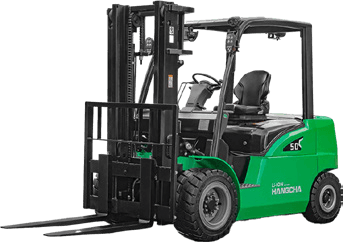
Counterbalance forklifts in high tonnage take on containers, massive palletized loads, timber, and bulky goods. Diesel powertrains and pneumatic tires are favored for their ruggedness, ground clearance, and footing on rough surfaces. Outdoors, two points deserve particular attention: corrosion resistance, facing damp and sometimes salt air, and the ability to travel over difficult terrain. The tonnage to be handled and the exact nature of the loads guide how the machine is sized here.
The store back room and retail
In retail and back-of-store work, space is tight and loads are lighter. Compact pallet trucks and low-footprint stackers are the best fit: they maneuver in cramped reserves, unload deliveries, and replenish shelves without demanding aisles sized for large machines. Compactness, maneuverability, and clean electric operation matter more than raw capacity.
Cross-cutting concerns for every sector
Beyond the sector, a few criteria recur in every choice:
- Floor and ground conditions: bearing capacity, flatness, and surface state shape both the tire type and the machine itself.
- Indoor or outdoor: this sets the power source, electric in clean enclosed areas, combustion on outdoor ground.
- Expected throughput: the handling rate drives how many machines you need and how capable they must be.
- Fleet flexibility: an adjustable fleet, partly rented, absorbs seasonal peaks without over-equipping for the rest of the year.
Answering these four questions before choosing heads off most sizing mistakes.
One supplier for a mixed fleet
Many operations combine several of these worlds: a warehouse, an outdoor yard, a store back room. The fleet then becomes mixed, with electric reach trucks, diesel forklifts, and compact stackers that share neither the same maintenance needs nor the same replacement cycles.
Working with a single supplier, able to cover sale, rental, maintenance, and after-sales, clearly simplifies managing such a fleet: one point of contact, a complete view of your machines, and consistency from the first piece of advice through to the breakdown call. For a mixed fleet, that continuity is worth as much as the choice of each machine taken on its own.
Whatever your sector, request a free needs assessment.