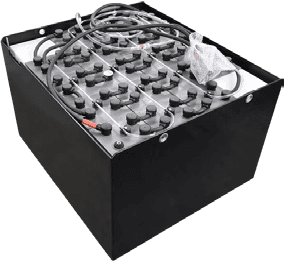
On an electric forklift, stacker or pallet truck, the traction battery accounts for a large share of the machine's value. It is also the one component whose lifespan depends almost entirely on day-to-day habits. A well-managed battery delivers years of reliable shifts; a neglected one can lose half its capacity within months. Here is what actually matters, whether your fleet runs on lead-acid, lithium-ion or a mix of both.
Lead-acid vs lithium-ion: what changes
The two chemistries play by different rules, and that is the first thing to make clear to your operators.
Lead-acid is still the most common technology in material handling. It is proven and cheaper to buy, but demanding: it wants full charge cycles, regular watering, and a ventilated charging area because it releases hydrogen toward the end of a charge. Properly maintained, a lead-acid traction battery typically delivers around 1,200 to 1,500 cycles.
Lithium-ion works the other way around. It handles partial charges very well, needs no watering, and does not gas under normal charging. Its built-in battery management system (BMS) protects the cells against deep discharge and overcharging. It costs more upfront but typically delivers 2,500 to 3,500 cycles, and it suits two- and three-shift operations thanks to opportunity charging.
| Criterion | Lead-acid | Lithium-ion | | --- | --- | --- | | Opportunity (partial) charging | Avoid | Recommended | | Watering | Required | None | | Ventilated charging room | Needed | Not required in normal use | | Typical lifespan | 1,200 to 1,500 cycles | 2,500 to 3,500 cycles | | Purchase cost | Lower | Higher |
The practical takeaway: any charging instructions posted in your warehouse should state which chemistry they apply to. A rule that protects a lead-acid battery can actively harm a lithium pack, and vice versa.
Charging habits that pay off
For lead-acid, the golden rule is simple: full cycles, no half measures. Put the battery on charge when roughly 20 to 30 percent of capacity remains, let the cycle run to completion without interrupting it, then allow the battery to cool before putting it back to work. Repeated partial top-ups wear the plates prematurely. A weekly equalization charge, which most chargers provide, keeps the individual cells balanced.
Lithium-ion is the opposite. Use breaks, shift changes and quiet periods to plug the truck in for twenty or thirty minutes at a time. The battery does not need to reach 100 percent every time, and it dislikes sitting for long periods either completely full or completely empty. If a machine is going into storage, aim for a mid-range state of charge, somewhere around 40 to 60 percent.
Three principles apply to both chemistries:
- Always use the charger specified for the battery, matched to its voltage (traction batteries typically span a 24-80 V range) and its capacity. An undersized or badly configured charger damages the battery a little more with every cycle.
- Charge in a clean, dry, temperate area. Heat is the number one enemy of every battery chemistry.
- Build charging into your shift planning instead of improvising. A truck that dies mid-shift always ends up being recharged under the worst possible conditions.
Watering and cleaning (lead-acid)
This is the most commonly skipped maintenance task, and the most expensive one to skip.
Check electrolyte levels weekly on a heavily used fleet, and at least every two weeks otherwise. Top up only with demineralized water, never tap water: the minerals it contains contaminate the electrolyte permanently. Two rules worth enforcing without exception:
- Water after charging, never before. Electrolyte levels rise during the charge, so filling a discharged battery leads to acid overflow.
- Never fill past the maximum mark. An overfilled cell spills, corrodes the battery tray and creates leakage currents.
Cleanliness matters just as much. A battery top covered in dust and acid residue allows leakage currents that drain the battery while it sits idle and accelerate corrosion at the connections. Wipe the cell tops regularly, and check that terminals, cables and connectors are tight and in good condition. Anyone working on a lead-acid battery should wear gloves and eye protection, and the charging area must stay ventilated.
The mistakes that kill a battery
A handful of habits will shorten a traction battery's life dramatically. The most common ones:
- Deep discharge. Regularly running a lead-acid battery below 20 percent causes plate sulfation, damage that is largely irreversible.
- Leaving a battery flat. A lead-acid battery left discharged for several days sulfates even while standing still. Always recharge before storing.
- Repeated partial charges on lead-acid. Plugging in for ten minutes at every break "just to be safe" wears the battery far faster than proper full cycles.
- Tap water, or watering before the charge. Two seemingly harmless shortcuts, two classic causes of premature battery write-offs.
- Ignoring temperature. Charging a battery that is still hot from an intensive shift, or working it in direct summer sun, degrades cells of every chemistry.
- The wrong charger. A mismatched voltage or charge curve wears the battery silently, cycle after cycle.
Lithium-ion is far more forgiving day to day, but it has limits of its own: extreme temperatures, impact damage to the casing, and non-approved chargers. The BMS protects the battery; it does not replace common sense.
When to consider replacement
Even with good care, every traction battery eventually reaches the end of the road. The warning signs to watch for:
- The battery no longer lasts a full shift that it used to cover comfortably.
- Water consumption climbs noticeably from one week to the next (lead-acid).
- The battery runs unusually hot during charging or operation.
- Voltage sags sharply as soon as the truck lifts a load.
- Cells are swollen, cracked or heavily corroded.
The commonly accepted benchmark: when a capacity test shows the battery delivering only about 80 percent of its rated capacity, it is considered end-of-life for intensive use. At that point you have several options to weigh: replacing faulty cells if the rest of the battery is healthy, replacing the battery outright, or switching to lithium-ion if your multi-shift operation justifies it. It is also a sensible moment to compare against rental, which shifts the battery question to the rental provider.
Regular battery monitoring (density readings, capacity tests, connection checks) can also be built into a maintenance contract. It is often the simplest way to get an objective picture of your fleet's condition and plan replacements instead of being surprised by them.
Need help with your batteries or your fleet? Request a free needs assessment.