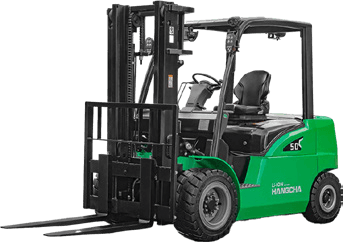
A forklift's load capacity is not a single number set in stone. Many operators remember the figure printed on the plate, say "2.5 tonnes," and assume the machine can always lift that weight. That is a mistake, and sometimes a dangerous one. Real capacity depends on the load center, the lift height, and any attachments fitted to the carriage. Understanding how these factors reduce the rated capacity is essential for operator safety, equipment integrity, and protecting your loads. This guide explains how to read the data plate and work out what your truck can actually lift.
Rated capacity and load center
Rated capacity is the maximum weight the truck can lift under precise reference conditions defined by the manufacturer. The most important of those conditions is the load center, the distance from the heel of the forks to the load's center of gravity. The standard reference is usually 500 mm, which matches a compact, well-balanced pallet.
As soon as a load is deeper or unbalanced, its center of gravity moves away from the mast. The leverage increases, and real capacity drops, even though the weight is unchanged. A load whose center sits at 600 or 700 mm puts more strain on the front of the truck and mechanically reduces the allowable weight. That is why two loads of the same mass do not handle the same way depending on their shape.
Reading the data plate and the capacity chart
Every truck carries a data plate that is legible from the operator's seat. It shows the model, the rated capacity, the reference load center, and often a capacity chart that crosses lift height against load center. That chart is the key tool: it shows how capacity falls as you lift higher or as the load center moves out.
Before any unusual lift, the routine is simple:
- Identify the real load center of your load, not the reference figure.
- Check the planned lift height, since capacity drops with height.
- Read the matching value on the chart, not just the rated capacity.
If the chart is missing or no longer legible, the machine has to go back through service: driving without a valid data plate means working blind.
Attachments, height, and residual capacity
Any attachment fitted to the carriage changes the capacity. A fork positioner, a clamp, a side-shift carriage, or fork extensions add weight out front and often push the load center further out. The result is a residual capacity lower than the rated capacity of the bare truck. That residual capacity must appear on a plate specific to the truck-plus-attachment combination; it should never be estimated in your head.
Lift height works the same way. The more the mast is extended, the more sensitive the whole assembly becomes to imbalance, and most manufacturers impose a reduced capacity beyond a certain height. Lifting a heavy load at the top of a double or triple mast is nothing like the same load near the floor.
| Load center | Indicative capacity | Effect | | --- | --- | --- | | 500 mm (reference) | 100 % | Nominal conditions on the plate | | 600 mm | Reduced | More leverage, capacity falls | | 700 mm | Sharply reduced | Deep load, narrower safety margin |
The exact values are always on your machine's chart; the principle is constant: the further the center moves out, the less the truck lifts.
The practical rule: weigh loads, never improvise
In the field, three habits prevent the vast majority of overload incidents. First, weigh real loads rather than trusting an estimate: a pallet quoted at one tonne sometimes weighs far more once loaded. Second, never add a makeshift counterweight or carry a person to "balance" the load: it is forbidden and dangerous. Third, never exceed the capacity the chart gives for the relevant height and load center.
An overload does not always cause an immediate tip-over. It wears the mast, chains, and transmission prematurely, undermines stability, and can drop a load with no warning. The safe approach is to keep a margin, especially at height and with bulky loads.
Unsure of your real capacity?
Working out the residual capacity of a truck fitted with attachments, choosing the right model for specific loads, or interpreting a faded chart is far from obvious. A technical opinion beats an approximation: a bad calculation is paid for in safety and broken equipment. If you are unsure what your machine can lift, or which equipment suits your loads, take stock with a professional.